
United States Secretary of War Pete Hegseth has rejected a CNN report claiming that the Pentagon's missile defence stockpiles have fallen to 'dangerously low levels' amid the conflict with Iran.

Torn between loyalty to their comrades and disillusionment towards the cause for which they are fighting, they are beginning to cave in. Morale has been the casualty, points out Vice Admiral Biswajit Dasgupta (retd).

US President Donald Trump has expressed strong support for the India-Middle East-Europe Economic Corridor (IMEEC), citing the necessity to move energy infrastructure away from Iranian checkpoints following attacks in West Asia. He made these remarks during a multilateral meeting with the Gulf Cooperation Council at the UN General Assembly, emphasising the corridor's role in overcoming regional challenges.
The ongoing US conflict with Iran has cost the Trump administration an estimated $45.1 billion, according to a Pentagon estimate provided to the US Congress on Friday, CNN reported, citing two sources familiar with the matter.

'On behalf of the Islamic Republic of Iran, I express gratitude and appreciation for my dear brothers HE Prime Minister of Pakistan Sharif and HE Field Marshal Munir for their tireless efforts to end the war in the region.'

A lesson for India is to clearly define objectives beforehand, so that the adversary or other parties do not attempt to mitigate them midway.

What we are watching is something different: A fog manufactured and maintained by the people who started the war, so that the question of why it was started never has to be answered, observes Prem Panicker in his must read blog on the war in the Middle East.

'We have lost 70-80 per cent of our business from foreign guests.'

The purge in Washington does not pause the war. Strikes continue, Hormuz remains closed, and Brent crude is still dancing around $109 a barrel. For India, the command chaos in the Pentagon is another layer of uncertainty piled on five weeks of conflict that was already straining every buffer Delhi has.

The US Senate passed a resolution directing then-President Donald Trump to withdraw American forces from the conflict with Iran. This bipartisan vote, though largely symbolic as a concurrent resolution, highlighted congressional concerns over potential escalation and a desire to limit presidential military authority without legislative approval.

The US military has lost at least 45 MQ-9 Reaper drones during the conflict with Iran, representing a quarter of its fleet and a significant financial blow. These losses, some due to communication failures, raise questions as India recently signed an agreement to procure 31 of these drones.

'American stature has been reduced because they have not been able to achieve their aims.'

Nobody takes Pakistan seriously and therefore Pakistan's sudden mediating with almost immediate results of a ceasefire seems more contrived than real, points out Vice Admiral Biswajit Dasgupta (retd).

Joe Kent, former head of the National Counterterrorism Center, accuses Israel of instigating the conflict between the United States and Iran, claiming there was no imminent threat from Iran.

Iran has conveyed seven conditions to the United States through Qatari mediators for starting negotiations to end the ongoing war, while warning that Tehran is prepared for a "decisive war" if Washington rejects its demands.

Chaffing under public ridicule in the US as well as internationally for having 'lost' the war, Trump is under immense pressure to do something, cautions Ambassador M K Bhadrakumar.

'Neither do the Israelis. The two attacking parties have very little economic interest in Hormuz.'

Speaking to North Korea's Supreme People's Assembly on Tuesday, Kim accused the United States of carrying out 'terrorism and invasions' across regions, referring to the ongoing conflict involving Iran.

On April 7, hundreds of activists gathered outside the White House in Washington, DC, to oppose American military involvement in Iran.

The US Central Command (CENTCOM) has launched extensive precision strikes across multiple Iranian military installations, deploying both one-way attack aerial and sea drones for the first time, to degrade Tehran's ability to disrupt international maritime trade in the Strait of Hormuz.
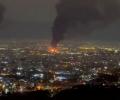
To be sure, Trump is furious, as the trajectory of the war is in a state of Zugzwang, as chess players call it. Trump and Netanyahu stare at two choices -- retreat in humiliation and concede Tehran's demands -- recognition of its rights, reparations, and binding security guarantees -- or perish in a quagmire, points out Ambassador M K Bhadrakumar.

US President Donald Trump stated that the decision regarding the conclusion of the conflict with Iran will be a 'mutual' decision made in coordination with Israeli Prime Minister Benjamin Netanyahu.

Indian hotel companies are experiencing a sharp correction in share prices due to the Iran war and broader geopolitical tensions, leading analysts to cut operating profit expectations and valuations, despite structurally positive medium-term prospects.

Markets face risk of a prolonged bear phase as oil shocks and geopolitical tensions test inflation, growth and investor confidence globally, points out Debashis Basu.

Pakistan is set to host the foreign ministers of Saudi Arabia, Egypt, and Turkiye to discuss a range of issues, including de-escalating tensions in West Asia.

The United States has paused a proposed USD 14 billion arms sale to Taiwan due to concerns about maintaining sufficient munitions for potential conflicts, particularly in light of the ongoing situation with Iran.

Citing sources familiar with the matter, the report said Trump believes the conflict is in its final stages and has urged aides to adhere to the four-to-six-week timeline he has outlined publicly.

US President Donald Trump has stated that the war with Iran is "close to over," while the US Central Command reports blocking traffic to Iranian ports.

The ongoing Iran-US conflict is casting a shadow over global cricket, potentially disrupting the IPL 2026 due to travel disruptions and logistical challenges.

Despite President Trump's optimistic prediction of a swift resolution to the ongoing conflict with Iran, Tehran dismisses any possibility of diplomatic breakthroughs, citing deep distrust and highlighting the complexities of US-Iran relations.
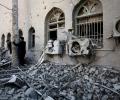
The logic of war plus the gathering storms in US politics as the midterms loom large leave him with no real alternative but to negotiate, points out Ambassador M K Bhadrakumar.

Congress leader Shashi Tharoor is urging the Indian government to take a more proactive role in mediating the escalating conflict between the US-Israel alliance and Iran, emphasising the impact on India's energy security and regional stability.

Donald Trump expressed confidence in a swift victory over Iran, suggesting military strikes before midterm elections are possible, with the primary goal of denying Tehran nuclear weapons. Meanwhile, Iranian Foreign Minister Seyyed Abbas Araghchi declared readiness for a "doomsday war" if hostilities resume, while also expressing openness to diplomacy if assets are unfrozen and oil sales allowed.

The US rejected Iran's proposal to reopen the Strait of Hormuz, citing Tehran's demands for sanctions relief and access to frozen assets before nuclear program negotiations. US Ambassador Mike Waltz called the offer a "cynical attempt," while Iranian Foreign Minister Seyyed Abbas Araghchi disputed Waltz's account and reiterated Iran's readiness for both diplomacy and renewed hostilities. President Trump expressed confidence in winning the conflict soon and keeping all options, including military strikes, on the table, with denying Iran a nuclear weapon as the primary objective.
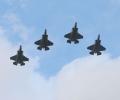
A Congressional Research Service report reveals that at least 42 US aircraft were lost or damaged during Operation Epic Fury, targeting Iran, with costs estimated to reach USD 29 billion.

Amidst escalating tensions in West Asia, Pakistan's defence chief visited Saudi Arabia to discuss regional security and the mutual defence pact between the two nations, focusing on de-escalation strategies.

US President Donald Trump has announced plans to clear the Strait of Hormuz to secure the vital oil corridor, citing risks to global energy supplies and criticising other nations' inaction.

In a bid to de-escalate Middle East tensions, the US has presented Iran with a comprehensive 15-point peace plan focusing on nuclear disarmament and regional stability in exchange for sanctions relief.

Iran's women's kabaddi team faced immense challenges during their Asian Games preparations, including frequent camp changes due to regional conflict, psychological stress on young players, and difficulties arranging international friendly matches due to sanctions.

Protests were held from coast to coast, with massive marches in major cities and smaller gatherings in suburban and rural areas across both traditionally Republican and Democratic states.
